In the Civil War Battle at Antietam, over 23,000 soldiers were killed, wounded or missing after twelve hours of savage combat on September 17, 1862. The Battle of Antietam ended the Confederate Army of Northern Virginia's first invasion into the North and led to Abraham Lincoln's issuance of the preliminary Emancipation Proclamation.

Monument at Antietam

Artillery at Antietam
Over 500 cannons participated in the Battle of Antietam, firing over 50,000 rounds of ammunition. The cannonade was so severe that Confederate artillery commander Colonel S.D. Lee described the battle as "artillery hell."

One month before the battle, President Lincoln declared:
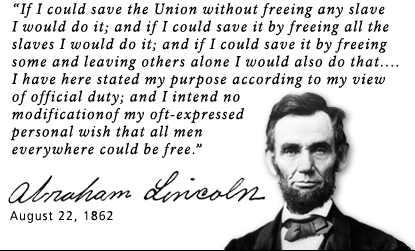
After the Battle of Antietam, Lincoln's cause became crystal clear and his focus became more narrow as he published the Emmancipation Proclamation. Emancipation Proclamation. Now the war had a dual purpose of
preserving the Union and ending slavery.
President Abraham Lincoln visited Antietam Battlefield two weeks after the battle and spent four days visiting General George McClellan, touring the battlefield and visiting the wounded of both sides.
|


 |
We found the BYU Road Traveler motorcyle-guy out with his filming crew documenting the Anteitum Battle Site. We waved and whistled as we passed and he, noticing our Utah plates, yelled back, "Go Cougars!"
|

Jodi harvested a stalk of wheat from a battlefield to go with her little Nauvoo horseshoe.
The First Texas Infantry lost 82% of their men killed, wounded and missing while fighting in the Cornfield at Antietam, the highest casualty rate for any Confederate regiment in one battle of the Civil War. http://www.historynet.com/battle-of-antietam-carnage-in-a-cornfield.htm
 |
| One section of the "Bloody Lane" where both Union and Confederate Soldiers fought and died. |

Original photo of some of the causalties of this horrific battle.


Original photo showing the bridge after the battle.

The bridge is now open only to foot traffic.


"The original Cemetery Commission's plan allowed for burial of soldiers from both sides. However, the rancor and bitterness over the recently completed conflict and the devastated South's inability to raise funds to join in such a venture persuaded Maryland to recant. Consequently, only Union dead are interred here. " http://www.nps.gov/anti/historyculture/places.htm

Cemetary Statue in tribute to the Union Soldiers who fought and died at Antietam.
 |
The Prophet Joseph Smith prophesied the terrible Civil War before his death. By the time the war began, the Saints were established in the Salt Lake Valley. As brutal as the exodus to the West was for the struggling members of the LDS Church, they avoided the destruction and devastation of this costly war.
|
